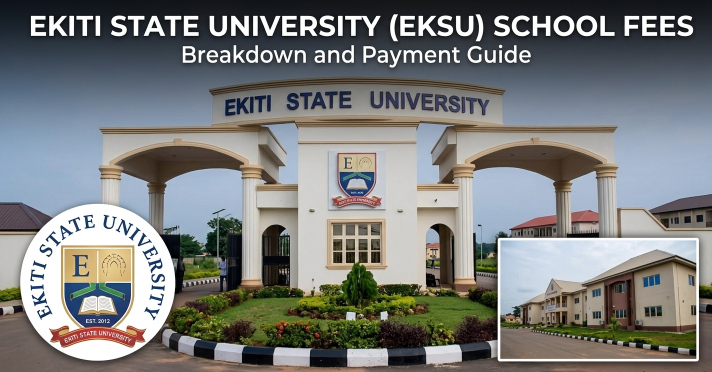
Ekiti State University, popularly known as EKSU, is a state-owned institution in Ado-Ekiti, Ekiti State, running degree programmes across Medicine and Surgery, Law, Pharmacy, Engineering, the Sciences, Agriculture, Arts, Social Sciences, Management Sciences, and Education. As a multi-faculty university with a large student population, EKSU structures its fees by faculty, department, level, and residency status, meaning a Medicine student pays a very different figure from an Education student, and residents pay less than non-residents throughout.
Understanding EKSU school fees matters because getting your exact figure right for your specific department, level, and residency status is the difference between smooth registration and unnecessary delays. This guide breaks down the complete fee schedule for every level from 100L to 600L, the acceptance fee structure, and the correct process for paying.
With dozens of departments spanning seven faculties and six levels of study, EKSU’s fee structure is genuinely one of the more detailed and layered systems among Nigerian state universities, which makes having the complete, organized breakdown in one place especially valuable for prospective and returning students alike.
Important Takeaway: EKSU school fees for new (100 Level) students range from ₦247,500 for Education (Others) up to ₦1,112,500 for Medicine and Surgery non-residents. Acceptance fees are set at ₦112,000 for Law, Nursing, Medicine/Surgery, Medical Laboratory Science, Pharmacy, Anatomy, and Physiology, and ₦62,000 for all other courses.
Fee Overview: How the Structure Works
EKSU school fees are determined by four factors working together:
- Faculty and Department: Medicine and Surgery sits at the very top of the fee scale, followed by Pharmacy, Law, Nursing, Medical Laboratory Science, and Medical Biochemistry, with Education programmes consistently at the most affordable end.
- Level of Study: Fees are highest at 100 Level and generally decrease as students progress toward graduation, reflecting reduced administrative and orientation costs in later years.
- Residency Status: Residents (students living in EKSU accommodation) pay less than non-residents across every single faculty and level.
- Acceptance Fee Category: New students pay one of two acceptance fee tiers depending on their programme, confirmed at ₦112,000 or ₦62,000.
Read also: Afe Babalola University School Fees (2026/2027 Session): Full Undergraduate Breakdown by College
EKSU School Fees: 100 Level (Freshers)
Here is the complete 100 Level breakdown for EKSU school fees, covering every faculty and department:
Acceptance Fee: ₦112,000 (Law, Nursing, Medicine/Surgery, Medical Laboratory Science, Pharmacy, Anatomy, Physiology) | ₦62,000 (All Other Courses)
| Faculty / Department | Residents (₦) | Non-Residents (₦) |
|---|---|---|
| Medicine & Surgery | 962,500 | 1,112,500 |
| Pharmacy | 655,000 | 755,000 |
| Law | 607,500 | 757,500 |
| Nursing | 607,500 | 757,500 |
| Medical Laboratory Science | 607,500 | 757,500 |
| Medical Biochemistry | 607,500 | 757,500 |
| Anatomy / Physiology | 532,500 | 607,500 |
| Engineering | 405,000 | 502,500 |
| Science (Zoology/Plant Science, Geology/Geophysics) | 382,500 | 472,500 |
| Mass Communication | 375,000 | 450,000 |
| Agriculture / Science (BCH, CHM, MCB, Biotech) | 367,500 | 457,500 |
| Arts (French, Theater & Media Arts, Others) | 330,000 | 405,000 |
| Social Science (GED/TRM/TAM/PSY) | 322,500 | 397,500 |
| Arts (English/History/International Studies), Social Science (Economics, Political Science, Others), Management Science | 307,500 | 382,500 |
| Education (Sciences, Geo/French/Tech, Human Kinetics) | 262,500 | 322,500 |
| Education (Others) | 247,500 | 307,500 |
EKSU School Fees: 200 Level Through 600 Level
Tuition eases considerably from 200 Level onward across nearly every faculty. Here’s how EKSU school fees trend across the remaining levels:
| Faculty / Department | 200L (Res./Non-Res.) | 300L (Res./Non-Res.) | 400L (Res./Non-Res.) |
|---|---|---|---|
| Medicine & Surgery | 1,024,500 / 1,174,500 | 697,000 / 797,000 | 797,000 / 897,000 |
| Pharmacy | 598,000 / 698,000 | — | — |
| Law | 549,500 / 699,500 | 347,000 / 447,000 | 347,000 / 447,000 |
| Nursing | 549,500 / 699,500 | 347,000 / 447,000 | 347,000 / 447,000 |
| Medical Laboratory Science | 549,500 / 699,500 | 347,000 / 447,000 | 347,000 / 447,000 |
| Engineering | 347,000 / 444,500 | 212,000 / 277,000 | 212,000 / 277,000 |
| Education (Others) | 220,000 / 280,000 | 137,500 / 177,500 | 142,500 / 182,500 |
By 500 Level, EKSU school fees drop further still, Medicine and Surgery settles at ₦493,000 (resident) / ₦586,750 (non-resident), Law at ₦192,000 / ₦255,750, Nursing at ₦173,000 / ₦235,500, and Engineering at ₦138,000 / ₦186,250. 600 Level, applicable only to Medicine and Surgery students in their final clinical year, is set at ₦498,000 (resident) / ₦591,750 (non-resident).
This declining pattern across nearly every department means students should plan for their heaviest financial year at 100 Level, with a generally lighter and more predictable cost each year after.
Freshers vs. Returning Students
The freshers-versus-returning distinction has substantial financial weight in the EKSU fee structure:
- Freshers (100 Level): Pay the highest tuition in their department’s fee track, plus the acceptance fee (₦112,000 or ₦62,000 depending on programme) that applies only once, at the point of admission.
- Returning Students (200L and above): Skip the acceptance fee entirely and generally pay a reduced tuition figure compared to 100 Level, though the exact trajectory varies by department, some faculties see tuition rise again at higher levels (as with Medicine and Surgery between 100L and 200L) before eventually settling lower in the final years.
This means EKSU school fees don’t decrease in a perfectly straight line year over year for every faculty, Medicine and Surgery students, for instance, should expect their 200 Level fee to be higher than their 100 Level fee, before costs ease significantly from 300 Level onward.
Acceptance Fee & Additional Charges
- Acceptance Fee (Higher Tier): ₦112,000, applicable to Law, Nursing, Medicine & Surgery, Medical Laboratory Science, Pharmacy, Anatomy, and Physiology, the professional and clinical-track programmes at EKSU.
- Acceptance Fee (Standard Tier): ₦62,000, applicable to all other courses across Arts, Social Sciences, Management Sciences, Education, Agriculture, and general Sciences.
- Residency Difference: Non-residents consistently pay more than residents at every level and in every department, the gap ranges from roughly ₦50,000 at lower fee tiers up to ₦150,000 at the higher end (Medicine and Surgery).
Note: Because EKSU’s fee schedule spans dozens of departments across six levels, always confirm your specific department’s exact figure through the official portal before finalizing your budget, the tables above cover the major categories, but sub-department variations exist within some broader groupings. This is particularly worth double-checking within the Sciences and Social Sciences faculties, where several closely related departments sit at slightly different rates depending on their specific specialization.
Detailed Step-by-Step Payment Process for Ekiti state university school fees
Here’s how to handle your EKSU school fees payment correctly:
Step 1: Confirm Your Admission Verify your admission status and department placement through the official EKSU admissions channel.
Step 2: Log In to the EKSU Smart School Portal Access your student account using your matriculation or application number.
Step 3: Identify Your Fee Category Confirm your faculty, department, level, and residency status to identify the correct tuition figure from the published schedule.
Step 4: Generate Your Invoice Generate your payment invoice through the portal, reflecting your specific tuition and, for freshers, the applicable acceptance fee.
Step 5: Complete Payment Pay through the official EKSU payment channel using your generated invoice, via bank transfer, card, or any other approved method.
Step 6: Print and Retain Your Receipt Keep both digital and physical copies of your payment confirmation for registration and clearance.
Step 7: Complete Registration With payment confirmed, proceed to complete your course registration for the session.
Installment Payment & Financial Aid
EKiti state university’s published fee schedule doesn’t specify a formal installment structure across faculties, so students facing difficulty raising the full amount should contact the Bursary directly to ask about any available flexibility, particularly for higher-cost programmes like Medicine and Surgery.
On broader financial aid, eligible students should look into the Nigeria Education Loan Fund (NELFUND), the federal government’s interest-free student loan scheme covering tuition and, in some cases, upkeep costs for students at accredited tertiary institutions. Since EKSU is a state-owned university, confirming current NELFUND eligibility directly through the official platform is worthwhile. Ekiti State indigenes may also want to explore state government bursary or scholarship schemes that could help offset costs further.
Scam Prevention & Safety Tips
CAUTION: All EKSU school fees payments should be made strictly through the official Smart School portal, never to an individual’s personal account or an unofficial “payment agent.”
- Only pay through the official EKSU Smart School portal, never through third-party sites or individuals claiming to process payments on your behalf.
- Be cautious of anyone offering to guarantee admission or a discounted fee for a “processing charge.” No legitimate shortcut exists outside the official admissions and payment channels.
- Confirm your exact department, level, and residency-specific fee directly on the portal before paying, given how many fee categories exist across EKSU’s faculties.
- Keep every receipt and payment confirmation in both digital and physical form.
- Verify any unfamiliar contact or phone number against EKSU’s official channels before responding to any admission or payment-related message.
Frequently Asked Questions (FAQs)
How much is EKSU school fees for Medicine and Surgery?
₦962,500 (resident) or ₦1,112,500 (non-resident) at 100 Level, rising to ₦1,024,500/₦1,174,500 at 200 Level, before easing to ₦697,000/₦797,000 at 300 Level.
How much is the EKSU acceptance fee?
₦112,000 for Law, Nursing, Medicine & Surgery, Medical Laboratory Science, Pharmacy, Anatomy, and Physiology; ₦62,000 for all other courses.
Do residents and non-residents pay the same EKSU school fees?
No. Non-residents pay more than residents at every level and in every department, with the gap widening for higher-cost programmes like Medicine and Surgery.
What is the cheapest faculty at EKSU?
Education (Others) is the most affordable, at ₦247,500 (resident) or ₦307,500 (non-resident) at 100 Level.
Do EKSU school fees decrease every year?
Generally, yes, from 200 Level onward in most departments, though Medicine and Surgery specifically sees a rise between 100 Level and 200 Level before easing significantly from 300 Level onward.
Conclusion
Understanding the full picture of EKSU school fees by faculty, level, and residency status puts prospective and returning students in a strong position to budget accurately each session. Whether you’re weighing a Medicine and Surgery seat at the top of the fee scale or a more accessible Education or Arts programme, EKSU’s detailed, published fee structure makes it possible to plan precisely rather than guessing from a single vague figure.
Since EKSU school fees can be reviewed by management from one session to the next, always confirm current figures directly through the official Smart School portal before making any payment, and never send money to an agent or unofficial contact claiming to process your admission or fees.
Bookmark campusfees.com.ng for continuous updates on EKSU school fees, admission requirements, and tuition breakdowns across Nigerian universities, polytechnics, and colleges of nursing.
This article will be updated as new fee information for Ekiti State University becomes available.

Abdulmalik Gadafi is an education content writer and the founder of Campusfees, a Nigerian platform dedicated to providing students with reliable information on school fees and other education-related costs. With over 3 years of experience researching and creating educational content, he focuses on making information about university, polytechnic, and college of nursing fees clear, accessible, and easy to understand. Through Campusfees, he aims to help students and parents make informed decisions about the financial aspects of education in Nigeria.

