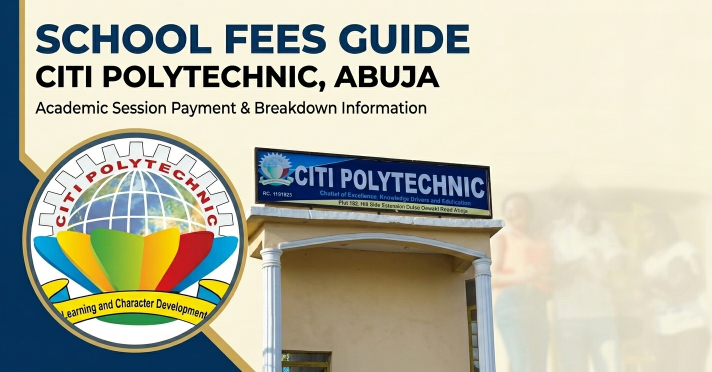
Citi Polytechnic, Abuja, is a private tertiary institution located at Plot 182, Hill Side Extension, off Panaf Drive, Dutse Dawaki Zone 7, Dutse-Alhaji, FCT Abuja. Approved by the Federal Ministry of Education and accredited by the National Board for Technical Education (NBTE) in February 2018, the polytechnic runs National Diploma (ND) and Higher National Diploma (HND) programmes across Engineering, Business, and ICT disciplines. Citi Polytechnic offers three distinct study tracks: Full-Time (2 years, maximum 4 semesters), Part-Time (2 years, maximum 5 semesters), and Open Distance and Flexible e-Learning (ODFeL) (5 semesters, delivered online through a dedicated learning portal). With admissions ongoing for the 2026/2027 session, prospective students are asking: how much is Citi Polytechnic Abuja school fees, and how does it differ by course and study track?
Getting this right matters because Citi Polytechnic runs genuinely different pricing depending on which track you choose full-time on-campus study is priced noticeably higher than the ODFeL distance-learning option, and mixing the two up when budgeting could leave you significantly short. This guide breaks down the confirmed fee structure, the courses available, additional charges, payment steps, and financial aid options, and clearly separates full-time undergraduate fees from the cheaper ODFeL rate so you know exactly what applies to your chosen mode of study.
Fee Overview: How the Citi Polytechnic Abuja school fees Structure Works
Citi Polytechnic Abuja school fees are made up of several components, and the total depends heavily on which study track you select:
- Tuition fee: the core academic charge, billed per semester, and varying slightly depending on department (Engineering courses vs. Business/Mass Communication courses).
- Institutional/administrative levies: Registration Fee, Library & ICT Access, and Examination Fee, all confirmed as separate line items on the official fees page, though exact amounts weren’t published.
- Accommodation: on-campus or nearby hostel costs, confirmed at ₦100,000–₦200,000 per session depending on facilities, for students who choose to live on campus.
- ODFeL-specific charges: Study Packs at ₦2,000 per course, which apply specifically to the distance-learning track and are bundled differently from full-time tuition.
Key takeaway: Citi Polytechnic runs three separate pricing structures for Full-Time, Part-Time, and ODFeL programmes. Always confirm which track your admission offer applies to before assuming a fee figure you’ve seen online is the one that applies to you.
Read also: Veritas University School Fees (2026/2027 Session): Complete Breakdown
Course & Department Fee Breakdown
The table below lists confirmed courses/departments at Citi Polytechnic, each carrying the same official ₦140,000–₦150,000 per semester range for full-time ND study, since the school has not published course-specific figures beyond this range.
| Course/Department | Programme Duration (ND) | Tuition Range (Full-Time, per Semester) |
|---|---|---|
| Computer Science / Computer Engineering | 20 months (ND); 17 months (HND) | ₦140,000 – ₦150,000 |
| Business Administration & Management | 20 months (ND); 17 months (HND) | ₦140,000 – ₦150,000 |
| Mass Communication | 20 months (ND); 17 months (HND) | ₦140,000 – ₦150,000 |
| Electrical/Electronics Engineering | 20 months (ND); 17 months (HND) | ₦140,000 – ₦150,000 |
| Accountancy | [CONFIRM if still active] |
₦140,000 – ₦150,000 |
Note: JAMB subject-requirement pages for Citi Polytechnic also reference Civil Engineering Technology, Marine Engineering, and Industrial Safety & Environmental Engineering Technology as acceptable disciplines under the general subject-combination guidance but these did not appear as confirmed, currently active course pages on the school’s own site at the time of writing. Confirm with the Admissions Office whether these are currently running programmes before assuming availability.
Disclaimer: Engineering-focused departments typically carry higher costs than Business/Mass Communication courses at most polytechnics due to lab and workshop materials Citi Polytechnic’s own page notes fees “differ slightly by department” without specifying which departments sit at the ₦140,000 end versus the ₦150,000 end of the range. Confirm your exact departmental total directly with the Bursary.
ODFeL (Distance-Learning) Fee Comparison
For students considering the online/distance-learning track instead of full-time study, Citi Polytechnic runs a separately priced ODFeL programme:
| Item | ODFeL Amount |
|---|---|
| Application Fee | ₦5,000 |
| Study Packs | ₦2,000 per course |
| Registration Fee | ₦25,000 per semester |
| e-Library Fee | ₦5,000 per semester |
| Tuition Fee | ₦63,000 |
| Others | ₦5,000 per session |
| Approximate total per semester | ~₦93,000 |
This is significantly lower than the ₦140,000–₦150,000 full-time rate, reflecting the reduced overhead of online delivery. If you’re comparing costs across tracks, confirm directly with Admissions which specific courses are available under ODFeL, since not every department may be offered in that format.
Read also:
Freshers vs. Returning Students: What’s Different
- Application Fee: A one-time charge for all new applicants; confirmed at ₦5,000 for the ODFeL track, with the full-time equivalent to be confirmed directly.
- Acceptance Fee: A paid only once, by freshers, immediately after admission is confirmed.
- Registration Fee: Charged per semester across both tracks, though this may be structured differently for freshers versus returning students.
- JAMB requirement: candidates need credit passes in five relevant subjects (English, Mathematics, Physics, Chemistry, and one other subject depending on the course) in not more than two sittings.
- HND admission: Requires completion of ND requirements plus a minimum lower credit pass from an NBTE-accredited programme, along with at least one year of post-ND cognate work experience in the field of specialisation; candidates with an ND pass grade may be considered with a minimum of two years’ post-ND work experience.
- Tuition itself: The ND programme runs 20 months and HND runs 17 months, and payment can reportedly be made each semester, on a course-by-course basis.
Acceptance Fee & Additional Charges
- Acceptance Fee: Non-refundable, paid once admission is offered; secures your slot in the programme.
- Hostel Accommodation: ₦100,000 – ₦200,000 per session, confirmed directly on the official fees page, depending on the specific facility chosen.
- Registration Fee, Library/ICT Access, Examination Fee: Listed as separate charges on the official fees page, but without published amounts confirm directly with the Bursary.
- Currency Note: The school explicitly states that payment in currencies other than Naira will be converted at the exchange rate applicable on the day of payment relevant for international or diaspora applicants.
- Fee Variability: The school states plainly that tuition fees and medical insurance fees are subject to change without notice, so always confirm the current figure close to your payment date rather than relying on a figure from months earlier.
Warning: Bank transfer is stated as the preferred payment method. Always pay directly to the account officially confirmed by the Citi Polytechnic Bursary or Admissions Office, never to a personal account or an unverified “agent” claiming to process payment on your behalf.
Step-by-Step Payment Guide for Citi Polytechnic Abuja school fees
Follow these steps when paying your Citi Polytechnic Abuja school fees
- Confirm Your Study Track
Determine whether you are enrolled in Full-Time, Part-Time, or ODFeL and identify your specific programme. - Visit the Official Portal
Go to the official Citi Polytechnic application portal or the appropriate ODFeL portal. - Check Your Fee Details
Review the applicable fees for your programme, level and semester before making payment. - Make the Payment
Pay through the designated official payment channel, such as the approved bank transfer or payment platform. - Collect Your Official Receipt
After completing the payment, obtain your official receipt or payment confirmation as evidence of payment. - Keep Your Payment Evidence Safe
Store both digital and physical copies of your receipt. You may need them during course registration, clearance and other administrative processes.
Since payments of Citi Polytechnic Abuja school fees can reportedly be made each semester on a course-by-course basis, keep a clear record of exactly what each payment covers this will help avoid confusion at registration time, especially if you’re taking a mix of core and elective courses.
Installment Payment & Financial Aid
Citi Polytechnic’s semester-by-semester billing structure already offers some built-in flexibility compared to a single annual lump sum. Whether further installment arrangements within a semester are available is not explicitly stated, confirm directly with the Bursary or Admissions Office if you need a split payment plan.
For students needing broader support:
- NELFUND (Nigerian Education Loan Fund): Confirm with Citi Polytechnic and the official NELFUND portal whether the institution is currently listed among accredited institutions eligible for disbursement, since private polytechnics vary in NELFUND coverage.
- FCT/State Bursary Schemes: Applicants from various states should check with their respective state bursary or scholarship boards for potential support, as some states extend bursaries to indigenes studying at accredited private institutions.
- Institution-based arrangements: Given the flexible, course-by-course payment structure already in place, it’s worth asking Admissions directly whether further flexibility exists for students facing financial hardship.
Scam Prevention & Safety Tips
- Only pay fees via bank transfer to the account officially confirmed by Citi Polytechnic’s Admissions or Bursary Office, this is the school’s own stated preferred method.
- Confirm which study track (Full-Time, Part-Time, or ODFeL) your admission actually applies to before paying, since the fee difference between tracks is substantial and a mix-up could mean paying the wrong amount.
- Never pay an “agent” or unofficial contact claiming to guarantee admission or a discounted rate outside official channels.
- Keep both a digital and physical copy of every payment receipt and admission confirmation.
- Since the school states fees are subject to change without notice, always reconfirm the current amount directly before making payment, rather than relying on a screenshot or figure from a previous session.
Frequently Asked Questions
1. How much is Citi Polytechnic Abuja school fees for full-time ND programmes? ₦140,000 – ₦150,000 per semester, varying slightly by department, according to the school’s official fees page.
2. Is Citi Polytechnic Abuja school fees the same for ODFeL and full-time study? No. ODFeL (distance learning) is priced separately at roughly ₦93,000 per semester total (₦63,000 tuition plus registration, e-library, and other fees), noticeably lower than the ₦140,000–₦150,000 full-time rate.
3. What courses does Citi Polytechnic Abuja offer? Confirmed programmes include Computer Science/Computer Engineering, Business Administration & Management, Mass Communication, and Electrical/Electronics Engineering, each running 20 months for ND and 17 months for HND.
4. Is hostel accommodation compulsory? No. Accommodation is optional, costing ₦100,000–₦200,000 per session for students who choose to stay in on-campus or nearby hostel facilities.
5. Can international or diaspora applicants pay in other currencies? Payments made in other currencies are converted to Naira at the exchange rate applicable on the day of payment; bank transfer remains the preferred method.
Conclusion
Since its 2018 accreditation, Citi Polytechnic has positioned itself as a practical, vocation-focused alternative among Abuja’s private polytechnics, running admissions into HND programmes alongside its ND offerings across engineering, business, and ICT disciplines. The polytechnic’s website emphasizes hands-on, industry-oriented training over purely theoretical instruction — a positioning reflected in its programme structure, which allows payment each semester on a course-by-course basis rather than one rigid annual lump sum. This flexibility, combined with the option to choose between full-time, part-time, and ODFeL tracks, gives prospective students more control over how they structure both their studies and their finances than a single fixed schedule would.
Citi Polytechnic Abuja school fees are clearly split between two very different price points depending on your study track: ₦140,000–₦150,000 per semester for full-time on-campus study, versus roughly ₦93,000 per semester for the ODFeL distance-learning option. While the school hasn’t published an exact per-course breakdown beyond noting that fees “differ slightly by department,” confirming your specific course, track, and total with the Admissions or Bursary Office remains the safest way to budget accurately, especially since the school explicitly reserves the right to change fees without notice.
Bookmark campusfees.com.ng and check back here each session for updated Citi Polytechnic Abuja fee breakdowns and payment guides.

Abdulmalik Gadafi is an education content writer and the founder of Campusfees, a Nigerian platform dedicated to providing students with reliable information on school fees and other education-related costs. With over 3 years of experience researching and creating educational content, he focuses on making information about university, polytechnic, and college of nursing fees clear, accessible, and easy to understand. Through Campusfees, he aims to help students and parents make informed decisions about the financial aspects of education in Nigeria.